

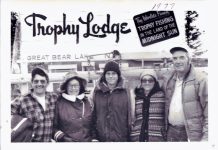

I’ve been known to refer to the Plummer’s as the “First Family of Arctic Sportfishing,” which by the way, is without question an irrefutable fact, and although it doesn’t garner as much attention and accolades as their lodge operations, they are also noteworthy aviation pioneers and innovators.
And as you read on, perhaps you may also come to the same conclusion I did, that it would not be untoward to also refer to them as “The First Family of Arctic Aviation.”
Warren, together with his son Chummy, who became a pilot at age 15, have been flying for over 70 years, a feat that I’m willing to wager, few others can match.
In the early 1940’s, Warren ran a flying service out of Sioux Narrows, Ontario flying fisherman to areas in and around the Lake of the Woods.
After visiting the Taltheilei Narrows on Great Slave Lake with his father in 1938, he decided to take guests – only 4 at a time when they first started – from Sioux Narrows to Great Slave for what was then, and remains to this day, that fishing trip of a lifetime, and as a result, Sioux Narrows Airways Ltd. was born.
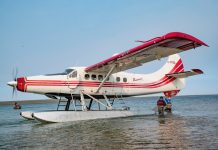
The trip from Sioux Narrows to Great Slave Lake was over 2000 km – or 1300 miles – and in order to get there they used such legendary aircraft as the C-64 Norseman, de Haviland Beaver, Beechcraft 18, Grumman Goose, Stinson Reliant and even a Barkley-Grow, which was a rare bird indeed, because only 11 were ever built, with just 6 making their way to Canada.
In fact, the Barkley-Grow and Stinson Reliant are now both museum pieces and can be seen in the Hanger Flight Museum in Calgary, and the Western Canada Aviation Museum in Winnipeg respectively.
Not to be outdone by his dad in terms of “rare birds”, the first aircraft that Chummy purchased was a Fairchild F-11 Husky, of which only 12 were built, and while this one never found its way into a museum, it was yet another in a long line of classic aircraft that were owned and operated by the Plummer family.
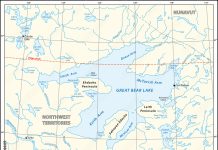
As the business grew from the Lake of the Woods operation and a small bunkhouse at Taltheilei Narrows, into full–service world class lodges on Great Slave Lake (1949), Great Bear Lake(1959), and Tree River (1960), guests were transported to the lodges from Winnipeg, Yellowknife and Kugluktuk, as well as to many other places throughout the Arctic using a wide variety of aircraft, that together with those already mentioned, also included the Douglas DC-3 and DC-6, de Haviland Otter, Hawker Siddeley HS 748, and eventually several types of jet aircraft.
Establishing and running a business – particularly an air service – in the Arctic is not for the faint of heart.
The operating season is extremely short, the weather unpredictable, and costs are significant, meaning that profit margins are skinny at best.
And just to make it even more interesting, toss in a global pandemic, together with an endless stream of increasingly stringent government regulations (which ultimately led to the decision to sell their DC-3), and you might ask yourself why anyone would even want to bother.
And while some folks have this romantic notion that having your own airplane and being a bush pilot means days filled with thrills, fun and adventure, to put it bluntly, that’s nothing more than a load of crap, because for the most part it’s damn hard work, and not without its challenges and dangers.
More often than not it involves long days, loading and unloading heavy, unwieldy cargo, and at times flying in extreme, constantly changing weather conditions, and in the early days before the advent of GPS, reliable radio communication and other modern navigational aids, it meant piloting an aircraft with nothing more than a compass, map, and your experience to guide you.
Although as Chummy, a true master of the understatement put it, “After so many years of flying, it’s just like driving a truck, so it’s really not that big a deal.”
Fortunately flying was not all hard work all of the time, and did have a lighter side as Chummy discloses in this YouTube video, while explaining the challenges that he, as a young pilot, was having keeping his aircraft in trim, while flying a Grumman Goose from Great Slave to Great Bear Lake.
Soon after Chummy and his dad moved the camp on Great Bear to its current location in 1967 (which is an amazing story in and of itself), Warren kicked off the mammoth task of putting in a gravel airstrip adjacent to the lodge, and not being content with having just one mega project on the go, that same year Chummy began building a strip on Great Slave.
Both were about 3000 ft. in length and originally built to handle DC-3’s, but as the business expanded, so were the airstrips, which were then lengthened so they could accommodate a DC 6, and consequently bring in even more guests at a time.
When Chummy first floated the idea of bringing in jets, Warren thought that he was perhaps a little crazy, but he persevered, widening and lengthening the strips on both Great Bear and Great Slave to over 5200 ft. and starting in the late 1970’s, added another chapter to the families rich aviation history by bringing guests directly to both camps from Winnipeg first on a Fokker F28, and subsequently on both Boeing 737 and 727’s.
These privately owned, and meticulously maintained airstrips are suitable for pretty much any aircraft that can land on gravel, including Falcons, Citations, King Airs and Hercules.
I don’t think its overstating it to say that taking on projects of this magnitude and complexity, without any government assistance whatsoever either financially, or in terms of overcoming the immense logistical intricacies in these remote, and virtually inaccessible corners of the Arctic, is by any measure a remarkable accomplishment, that required vision, innovative thinking, singularity of purpose, and more than just a little ice water running through their veins.
When Plummer’s first opened their camp on the Tree River, they flew guests in on a Grumman Goose, but once they acquired a DC 3, which they eventually named “Tree River,” Warren thought it would be a good idea to use that to ferry guests and supplies to the Tree, and set about the task of building an airstrip on the tundra, not too far downstream from the camp.
Having other more pressing matters to deal with, Warren put the project on hold, but when Chummy eventually took over lodge operations, he completed the strip in the early 1980’s.
Getting the equipment needed to build and maintain an airstrip up to Great Slave and Great Bear was one thing, but transporting the necessary heavy machinery all the way up to the Arctic coast was an entirely different matter – some might even say impossible.
Well, I suppose if Warren and Chummy had let the word “impossible” get in the way of their plans, they would still be using relatively small float planes and the like to move people, equipment and supplies around, with the result that the business would likely have never grown to where it is today.
Concluding that the only practical way to get the heavy machinery up there was in the belly of a Hercules, and with the closest airstrip being in Kugluktuk, some 130 km’s or 80 miles away, they would have to improvise, and figure out a way to put the Herc. down on the sea ice.
And just to put this undertaking into some perspective, a Hercules weights 34,400 kg, or damn near 76,000 pounds – and that’s before you pack the hold with heavy construction equipment.
While the Hercules was on the ground in Kugluktuk, Chummy, together with the Herc. pilot, flew a Cessna 185 over to Tree River, and circled around until they found a spot clear of snow that was long enough, and the ice thick enough for the Herc. to land on, and the rest is as they say – history.
They somehow managed to get the machinery from the coast to where Warren had started building the airstrip, and once completed, guests were then able to take the “DC-3 to Tree.”
On a final note, Warren and Chummy, given their many accomplishments in the field of aviation, and ongoing contributions to the economic development of the Northwest Territories and Nunavut, deserve no less recognition than other notable Arctic aviation pioneers and innovators, such as Fred Carmichael, Willy Laserich, Stan McMillan and Max Ward, and are indeed worthy of being inducted into the Canadian Aviation Hall of Fame.